Baby Bonds Explained: Structure, Risks, and Rewards
At $25 par and traded on an exchange like a stock, baby bonds are genuine debt with a stated maturity and contractual interest, ranking senior to preferred stock from the very same issuers.
What Is a Baby Bond?
The term "baby bond" refers not to a bond issued by a small company, but to a bond issued in small denominations.
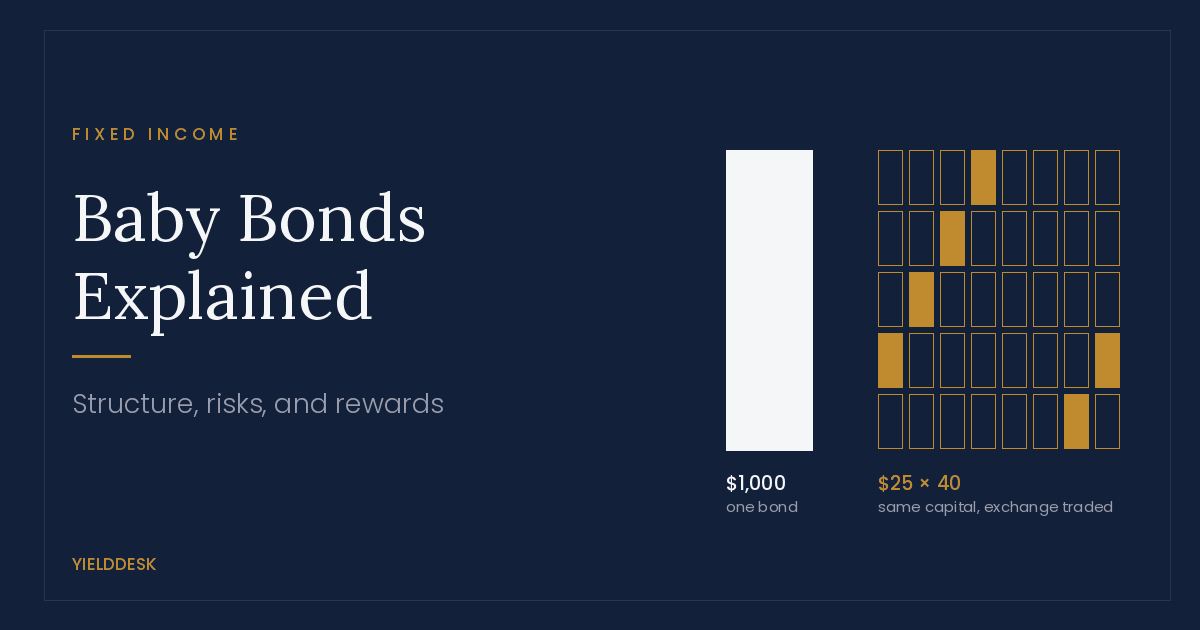
Where a conventional corporate bond typically trades in $1,000 increments and is purchased primarily by institutions in an over-the-counter market, a baby bond is issued at $25 par, the same denomination used for preferred stock, and trades on an exchange in the same manner a retail investor would buy a share of common stock.
Why the Structure Matters
Baby bonds are, legally, debt—most often unsecured notes issued under an indenture with a trustee acting on behalf of holders. They carry:
A stated maturity date
A fixed coupon
A legal claim that ranks ahead of preferred stock and common equity
Unlike preferred dividends, baby bond interest payments cannot simply be skipped without triggering a default. This gives holders contractual remedies, including acceleration of the debt, that preferred shareholders lack.
Who Issues Baby Bonds?
The issuer base for baby bonds differs somewhat from the preferred market. Business development companies (BDCs) are prolific issuers, in part because regulations governing their leverage make exchange-traded notes a convenient funding channel.
Other frequent issuers include:
Insurance companies
Specialty finance firms
Shipping companies
Smaller capital-intensive businesses
For some issuers, the retail note market is not merely a supplement to institutional borrowing—it can be a substitute for it. This is an important consideration when assessing credit quality across the category.
Long Maturities, Shorter Practical Lives
Maturities tend to be long. Many baby bonds are issued with terms of 25 to 40 years, and some extend to the 2050s and beyond.
In practice, however, few survive to maturity.
Nearly all issues become callable at par roughly five years after issuance, and issuers routinely redeem and refinance when rates permit. As a result, the market often prices baby bonds based on the call date rather than the stated maturity date.
Key takeaway: The stated maturity can significantly overstate the security's expected life.
The "Flat" Trading Convention
A mechanical detail distinguishes baby bonds from conventional bonds at the point of trade.
Most exchange-traded notes trade "flat," meaning accrued interest is embedded in the market price rather than calculated and added separately at settlement, as it is in the institutional bond market.
Prices therefore tend to:
Rise gradually as an interest payment date approaches
Drop by roughly the payment amount on the ex-date
This pattern can be misleading to investors unfamiliar with the convention.
Tax Treatment
Taxation differs as well.
Baby bond payments are interest, generally taxed as ordinary income, and do not qualify for the favorable rates applied to qualified dividend income.
This distinction can make tax-advantaged accounts particularly relevant when considering these securities, where practical.
Baby Bonds vs. Preferred Stock
The tradeoff for a baby bond's improved position in the capital structure is typically a somewhat lower yield than a comparable preferred issue from the same company.
The relationship is not fixed, however. The yield gap can widen or narrow during different points in the credit cycle and can occasionally invert for structural or technical reasons.
At a high level, investors are weighing:
Baby BondPreferred StockLegal debt obligationEquity securityRanks ahead of preferred stockRanks behind debtInterest payment is contractualDividend can generally be suspendedHas a maturity dateUsually perpetualCreditors' claim in bankruptcyResidual claim after creditors
In effect, the investor is trading a modest yield concession for materially stronger legal protection.
What Happens Under Stress?
Where the two instruments diverge decisively is at the point of financial stress.
A company under pressure can suspend its preferred dividends indefinitely while continuing to service its notes. Boards may do precisely this because failing to service debt can result in default.
In a bankruptcy proceeding, baby bond holders stand in line as creditors, with a legal claim to repayment, negotiating position, and, frequently, a meaningful recovery.
Preferred shareholders stand behind them with no comparable claim and can be wiped out entirely.
What Investors Should Check
For income investors building a ladder of fixed-income-like securities, the distinction between debt and preferred equity deserves more attention than the yield spread alone might suggest.
Before purchasing any $25 exchange-traded security, investors should read the prospectus and confirm exactly what the instrument is.
The exchange listing, $25 par value, and quarterly payment schedule can make different securities look almost identical from the outside.
What differs is everything that matters when conditions deteriorate.